

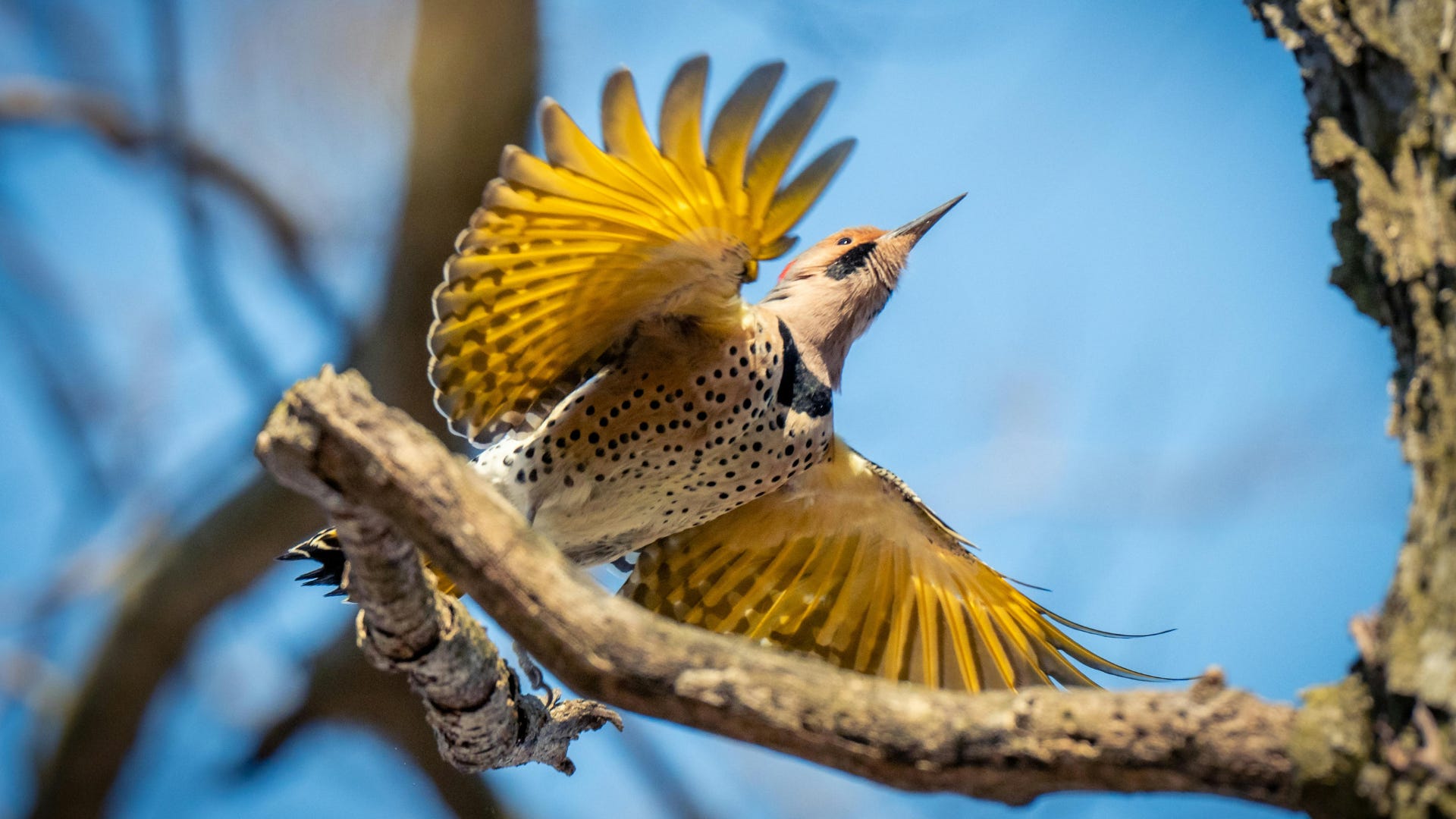
Welcome to The Nature Crow, my weekly column wherein I share shiny bits of nature, human and otherwise, from my cache. These columns are generally unrelated to my horse and donkey shenanigans. I do not send them to subscribers’ emails; instead, folks can find them here on Look Howeward, Horse as they wish. I’ve set up a Nature Crow tab.Enjoy today’s ramblins about Northern Flickers!

Recently, while horseback riding in the woods, I spotted a handful of brilliant yellow feathers on the ground. Struck by the unexpected slash of color against the brown leaves, I dismounted and examined them closer. These woodland treasures were tail feathers from a Northern Flicker. Holding them in my hand, I was immediately transported to my childhood yard, staring up into the tall loblolly pine trees, with my father beside me pointing to a bird perched on a branch.
“That’s a Northern Flicker,” he said, “Alabama’s state bird, nicknamed yellowhammer.”
I was impressed with its speckled chest and that bright, red dollop on the back of its head. This bird looked like it had been to a feather sale and chosen some of everything. Most surprising was the yellow plumage visible on its underside when it flew away. How did this gray, speckled bird transform into a canary-yellow bird just like that? What a wonder. I decided then and there that I liked this bird with its coat of many colors.
Smiling at the memory, I got back on my horse and rode on, pondering flickers.
Flickers are woodpeckers who, unlike other woodpeckers, get their tasty meals of ants, seeds, berries, and fruits from the ground, not trees. With their brilliant yellow feathers and habit of hammering the ground, flickers were called yellowhammers long before Alabama was known as the Yellowhammer State.
Alabama adopted its nickname during the Civil War, when a cavalry of soldiers up in Huntsville added a unique touch to their uniforms -- yellow sleeves, coattails, and collars against their Confederate Grey jackets. Folks jeered, comparing the soldiers to yellowhammers. Rather than skulk in embarrassment, the boys puffed up their chests and owned the comparison. They became known as the Yellowhammer Company. The nickname spread, and in time, all Alabama Confederate troops were referred to as yellowhammers.
How do you like that? I grew up right here in Alabama and I never knew where the nickname Yellowhammer State came from.
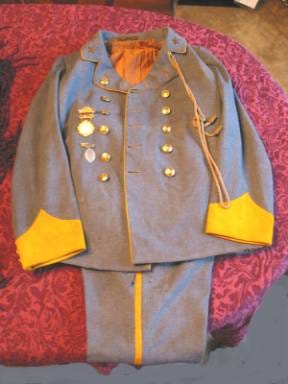
In 1927, Representative Thomas E. Martin introduced a bill to name the Northern Flicker, or yellowhammer, our state bird based on this tale. The bill passed, and here we are.
If you ask me, the Northern Flicker is one of the most beautiful birds in the state. Every time I see one, I feel lucky. Unfortunately, I don’t see them as much as I used to. For that matter, I don’t see any wild animals as much as I used to, save for white-tailed deer and summer mosquitoes. Upon reading about flickers in Alabama, I learned that although their conservation status is listed as moderate, their numbers are decreasing. Reasons for this decline include competition with invasive starlings, pesticides on lawns, degradation of habitat, climate change, building collisions, and predation by cats. No surprises here.
The catastrophic collapse of species on our planet is so daunting that it feels impossible to fix. In order to slow the madness, much less recover from the damage we’ve done to our fellow inhabitants of Earth, we need sweeping, international, sharp-toothed reform. We need a whole planetary mind-shift. Other than casting our votes toward folks inclined to care about the world we leave for our grandchildren, adopting a few changes at home can bring happiness to a flicker or two in our neighborhoods.
We can start by letting our lawns, or at least patches of them, go native, and lay off the pesticides that kill their buggy food sources. We can leave our dead trees standing, as flickers nest in cavities in snags. They also forage in branches and woody debris, so we can leave limbs and nurse trees resting, or move them to the edge of our lawns. Folks swear by suet, and I hear there is even suet which contains insects that flickers particularly enjoy. There is a good bit of information available on the internet about specialized flicker boxes for purchase or building if you’re wary of leaving dead trees around your house.
Let’s return to those feathers out there in the woods. Did I pick them up and stick them in my hat? The Migratory Bird Act, a federal law, prohibits possession of feathers from most native North American birds including woodpeckers, cardinals, blue jays, and mockingbirds. What about wild turkeys? Illegal, unless you harvested them from a turkey you hunted and killed legally. Vulture feathers? Nope. Illegal.
I’ve heard folks decry this ban on feather possession as overreach. I disagree. I’m all for any law that protects our wildlife. The pendulum can’t swing far enough away from the cruel and mindless destruction we’ve wreaked on nature. We can sacrifice a feather in our collective cap.
Hats off to our Alabama state bird, and to all the folks doing what they can to coexist with wildlife here in our yellowhammer state and beyond.
Thank you for reading this week’s edition of The Nature Crow. If you enjoyed this column, you might like my books of collected columns, Behold: Essays Into Wonder and Box Turtles, Hooligans, and Love, Sweet Love. These books are written for a curious, wonder-seeking, animal-loving, nature-thrilled community of readers. Maybe they’re written for you.
Visit my website, marydansak.com, for information and links to order copies.
Love hard and live wild,
Mary
PS Here is a delightful video clip with that FABULOUS orchestral piece composed by Leroy Anderson called “The Typewriter” behind it. It’s dated. I’m now at 199 columns, and due to my five day visit to the hospital, I’ve now missed one week. Enjoy!
In 1931 the American Robin was designated as the Michigan State bird.
I love the yellowhammer that occasionally visits the feeder, just breathtaking, every time! And now I know the tale. And tail. It’s usually the little downy peckers that visit and they seem to be flourishing. I’m sure I’ve also broken the songbird feather law (unwittingly) many times but know better, now.